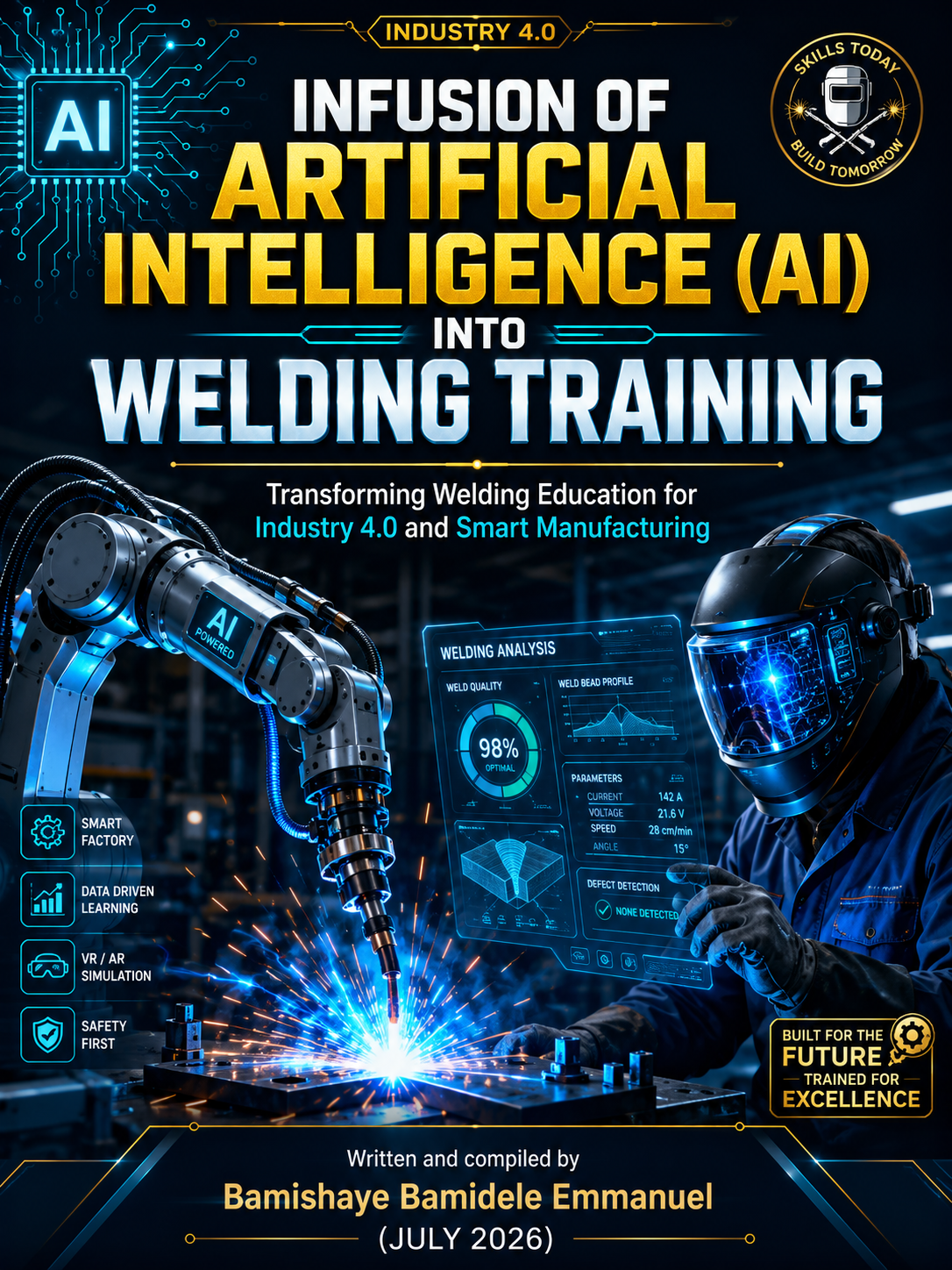
INFUSION OF ARTIFICIAL INTELLIGENCE (AI) INTO WELDING TRAINING

ABSTRACT
Artificial Intelligence (AI) is transforming industries worldwide, and the welding profession is no exception. As manufacturing enters the era of Industry 4.0 and smart factories, welding education must evolve from conventional instructor-led practical demonstrations to intelligent, data-driven, adaptive, and technology-enabled learning environments. AI is no longer limited to robotic welding systems in industries; it is now becoming an essential component of welding training through intelligent tutoring systems, virtual reality (VR), augmented reality (AR), machine vision, learning analytics, predictive assessment, digital twins, and automated performance evaluation.
The infusion of AI into welding training improves safety, reduces material wastage, personalizes learning experiences, accelerates skill acquisition, enhances assessment accuracy, and better prepares graduates for modern industrial workplaces. However, effective implementation requires significant investment in infrastructure, instructor retraining, curriculum redesign, cybersecurity, and ethical AI governance.
This article examines the concept, applications, benefits, challenges, implementation strategies, and future prospects of AI-enabled welding training.